Clicky Web Analytics

Wednesday, May 21, 2008

Because I can't bear to write...


...here's another photo post. N and her father discovered a train of ants in our jade plant. So this delicious-looking soap solution was made (using the tandurusti ki raksha karne wala Lifebuoy) to pour on the plants. Ironically, the jade's leaves were ruthlessly plucked by n and shucked into the solution, making it a lovely Zen-like discovery of a morning for me. When you're feeling as low as I am, even small things give pause for thought.

N, meanwhile, has been feeling triumphantly evil over her 'cruelty' and has cast herself in the role of a witch. She keeps humming to herself as she sprays the plants: 'Sprinkle, sprinkle, sprinkle / I'm here to pour Lifebuoy water on you...' Struck by the lurid strawberriness of the potion, she rushed and got a sticker of a strawberry and stuck it on the outside of the plastic container so that, she said excitedly, 'the ants will see it and think it's a tasty strawberry milkshake, and then they'll drink it!' I could almost hear the mean 'muwahahaha' laugh in her voice.


Thursday, May 01, 2008

In Manori...


...Man meets hammock,


Child meets bullock cart.


Crab colonies on the beach - less fragile, it strikes me, than human life.


N's first drawing ever - inspired by the softness of the sand, and framed by a fatherly toe. In case you're wondering, it's a flower with a leaf. Wonder if any of the aforementioned colonies were sacrificed while creating this.

Friday, February 22, 2008

Tag! I'm it.

I've had a dull sort of day. Finished off two bits of work yesterday, and thought I'd give myself a rest. Spent the day feeling d-u-l-l. Read other people's blogs and loved the way the write, and felt like I shouldn't be writing at all, since I can be neither brief nor clever. Then found this and it cheered me up mariginally - in the way pop quizzes in magazines used to when I was younger. So here goes.

A -Available?
In my dreams.

B-Best friend:
Umm. Am a Hard Kaur these days, and not thinking 'bast frands' at all.

C-Cake or Pie?
Actually, paal payasam, pressure-cooked till it's light pink.

D-Drink of choice:
Can't believe I'm saying this: Peach Iced Tea

E-Essential thing used everyday:
Chashma and cushion!

F-Favourite colour:
Turquoise maybe, or red, or sea-green.

G-Gummi bears or worms:
Worms, any day. I hate GBs.

H-Hometown:
Chembur

I-Indulgence:
Comics - like Bloom County, Doonesbury, Asterix and Tintin

J-January or February:
January. It has so many possibilities.

K-Kids and names:
One. N.

L-Life:
Short, painful, brutish. But with some lovely moments, of course.

M-Marriage date:
Dec 8

N-Number of siblings:
One

O-Oranges or apples:
Oranges

P-Phobias:
LIZARDS!!

Q-Quote:
Mars needs Moms!

R-Reason to smile:
N. She makes me grin, giggle, groan.

S-Season:
Monsoons

T-Tag three people:
Can't. Practically all the other bloggers I know have had this done to them. Will tag just one, and hope Paro doesn't mind it.

U-Unknown fact about me:
Better let it stay that way, no?

V-Vegetable you do not like:
Paapdi

W-Worst habit:

Talking on the phone. Incessantly. Being able to not work even when there is a lot to do.

X-x-rays you have had:

Many.

Y-Your favorite food:
Oh god, where do I start. I LUHVE food. Dahi batata puris and chicken biryani are the stuff I dream about.

Z-Zodiac:
Scorpio

Thursday, February 21, 2008

The Gourami also rises

I’ve always, always longed for a fish tank. Or maybe just one bowl, round, perfect, like a bubble with a golden blob of a fish bobbing in it. Growing up there was no question of it, of course, people at home wouldn’t hear of it. Then, with Amit, there were these prolonged discussions when he’d say, “I’ve had a fish tank, and the fish keep dying, and you’ll feel sad…” Hahaha, I’d laugh out loud, my head thrown back evilly, and say that I see fish only as food, not as friends at all, so no one’s going to catch me feeling really sad about a dead fish. Which, for some reason, instead of reassuring him, only made him blanch.

Time passed and n happened, and we got given a betta fish in a tiny fishbowl by Priya. She had researched the fish carefully: it was a native of the paddy fields of Laos, and was a loner (not for nothing was it a.k.a the Cambodian Fighter), and breathed air from the surface. So a.) it liked small spaces, and b.) didn’t need an oxygen pump. Most importantly, it didn’t like or need company.

Two days after the betta – who n named variously: ‘black-and-white’, ‘spotty’ and ‘swimmy’ – came home, we googled it and found that you should change the water every two or three days to prevent toxicity. With great care and dexterity we transferred it from small bowl to large bowl via a tea cup and an old sieve and it never once popped out and writhed as we were told fish do when you change the water. Yes, well, that done (we nearly sprained out pecs patting ourselves on our backs), we set out for some photo session at n’s school.

Back home an hour later, I looked at the fish, thought there was something odd about it, peered closer and saw that it was belly-up. Of course. The net doesn’t warn you about the chlorine in Mumbai’s water and how you need to pour in a de-chlorinating fluid before you blithely change the fish’s immediate environment.

Calmly I called Amit, who was first sad, then bitter, then devastated – when he heard of the chlorine thingy. That evening he flushed it away mournfully, as I patted his back. For days he lectured us about the pitfalls of having a fish at home; and how he wasn’t worried about himself, but see how it was upsetting ‘everyone’. N registered it in passing, but, typically of someone her age, I think, discussed it only days later when I was asked, ‘Why Swimmy died, amma?’ Before I could think of a suitably deep and yet simple answer, she said, ‘Now Swimmy dead no, so you must get me a pet rabbit.’

Now the grandma has taken it on herself to get a new fish and make it survive, or else. So today – despite parental disapproval – a Golden Gourami has come home. With blue pebbles for company and a packet of dried Red-Sea worms, and a bottle of de-chlorinating fluid. He / she is from the Laotian paddy fields (where there must be no fish left at all), a cousin of our old friend the betta. We are still not sure of the aggression levels (some sites say Gouramis love company; others say they just love to eat company), so the poor sod just has us and the pebbles to look at.

He / she is a stunner, though. Gold and with black stripes and spots, and with a lovely pair of long, thin whiskers… Fingers crossed that this one doesn’t end down the loo as well!

Thursday, February 07, 2008

Kapkapi - The Shivers

I hate the cold. I’m from the coast originally and have lived in Bombay all my life, and I’ve realized now, through this oddly cold winter, that I like my weather muggy, hot and squelchy. I love the normal Bombay winter because it is merely a state of non-heat; one where the mercury drops to say, 27, and we’re all like, ooh, there’s a nip in the air, do you feel it? Lovely, no? Delhiites and other Northerners look at you, one eyebrow raised, and say, call this a winter? You should see the ball-breakers we have back home.

No thank you, I say, keep your winter snobbery. It’s warm weather for me (regardless of how much I crib in summer). It’s so cold this year that - unusually for this city - you don’t need to turn on the fan ever. And if you do, it’s only to keep away the mosquitoes. It's so cold that you got out in the evening for a walk, the wind blows, and leaves a welter of angry goose pimples on your skin. Forget nippy, it’s like the air has grown a million sharp little teeth with which it bites into you. I’ve seen people shivering and huddling around makeshift fires all over Chembur, fergodssake, and I cannot tell you how unlikely a sight that is.

I do not like the strange sense of stasis that this cold brings: the reluctance to put my feet on the chilly floor, the numbing cold of the water that flows out of taps, the fact that we don’t have the woollies or the mindset needed to take this weather on the chin. I don’t like it being so dry that my skin stretches after a bath simply because it’s too darn cold to cream up before you cover up. I hate the thought that if we find it hard to cope living in our warm flats, how horrendous it must be for street people, and even for the average, very poor Bombay-ite who doesn’t have the money to buy warm clothes.

I wouldn’t want to agree with any of the Thackerays on anything, but when young Raj Thackeray calls Vilasrao Deshmukh Khallas-rao (khallas means the end, destruction), I find myself pausing to think. Apart from selling off all available open spaces to the builder’s lobby, the man has other fine points. One of them is a blind-spot towards the very poor – evident in his cruel, totalitarian slum-demolition drives. You’d think any right-thinking government would start some donation drives of warm things, or maybe give away blankets to the poor. Some way to help people who have always lived in a balmy city to deal with the cold, right? Nothing short of a cold wave and people dying would wake this one up.

The bitter cold puzzles n too. She asked me, “Why this winter not going away, amma?” Why, indeed. It reminded me of my friend Gouri Patwardhan’s film on seasons. It had a small animated traditional story – an Eskimo myth about the rotation of seasons – called Kapkapi. One year, Old Man Winter refuses to leave the earth. People shiver and huddle together, because the trees and plants have shrivelled up and died, and they have run out of food and firewood. There’s frost and ice everywhere.

Finally they pray to the Sun and he comes down. “Go away!” he says to Old Man Winter, which just makes the short, bearded, dark-eyed fellow angrier, more determined to stay. Grim, sullen, he waves a fat palm at the sun dismissively. The sun blows at him, a warm, yellow-orange breath that makes him shrink till he finally sits on a white owl and flies off.

I love this little sequence because Gouri’s rounded figures and lovely colours are so delightful. In the climax, the ice on a pond cracks, the water gleams through and then morphs into colourful birds. It’s breath-taking. Done in pre-comp days, the entirely cel animation has a lovely, uncluttered feel to it. The vo, because it was recorded back in them days, is dire. But watch it a couple of times, and you begin to enjoy the animation and forget the sepulchral narration. Weather like this really makes me think of those shivering people and how they must have longed for the balmy touch of spring. Wish I could find an image and put it here, but hard luck on that one. Might rig up something in the future though, so watch this space.

Any winter food favourites? Mine is the lovely sweet potato snack outside CP in Delhi And of course Sindhi Camp’s artery-hardening fried pakwans.

Thursday, January 17, 2008

Brown-paper packages...

I once raised a storm when I was 8. I was a bit of a dimbulb, loser type of kid, and had banded up with three nice, equally low-wattage girls in class. One was called Lorraine, the other was a tam-brahm called Savitha, and I am sure there was a third, only I can't right now recall her name or face. Our school had a wonderful demographic - there were the few very rich, and then there was everyone else. Both Lorraine and Savitha came from homes that were slightly disadvantaged and frugally middle-class respectively. At school, we only gave out sweets for birthdays, and with my ‘group’ there were no birthday parties or sweets or anything, till one day I was told at home that it was my birthday next week.

No one at home was really saying anything about any party, and I had had one the previous year, so in my slightly duh way, I decided to take matters into my own hands and invite S and L over, and maybe, well, shoot the breeze a bit? Eat some cake, perhaps? You know, just hang out some? Thursdays were our weekly off, and I asked them to come over, at, say, six pm? Comes Thursday morn, and just as mom was setting out to office, I remembered the party. I mentioned it to her, casual like, and the house imploded around me. My mom was / is one of the chilled-out-est people on earth, but even she completely freaked. Cousins were sent out to get cake and who knows what else, while I just sat back, frankly a bit dazed by the yelling and the scurrying. That evening when all of my three guests – S, L and S’s brother came – it was a bit of an anti-climax. I think the family were expecting droves and were a bit startled to see the rag-tag company which walked in. After that, the memory grows duller – I remember everyone looking a bit
embarrassed, and that’s it. My memory spikes again at one point – S had got me a tiny paperback of Birbal the Wise. It was from a popular, cheap imprint of them days, but I can’t remember the publisher’s name. I studied it for days and weeks later, turning it around and marveling at its small, rectangular perfection. It was the only gift from a fairly disastrous birthday party (I still didn’t know what I had done so bad), and I was soooo delighted, so grateful.

Why I remembered this is because N walked in from school today loaded – as usual – with a bag of 'return gifts'. For some reason, in her school, every child hands out these bags full of amazingly crappy, expensive,
prodigiously over-packaged stuff. Today, for example, she came in with a toy gun, a mask, a monginis three-cake set called 'stripe tease', two toffees – all tossed into a plastic bag. Costing – at the very least – 40/- per head, and there are 52 kids in class. Do the math. And this is one of the smaller return gift packs. There are days when she gets bigger things, and more of them – cups, sun visors with dark-glasses built in, imitation patent leather back-packs, tetra packs of drinks, lays, perks, and more strange Chinese chocolates. And they are all, without fail, looked at for two minutes and then forgotten.

There’s very little thrill left in gift-receiving or giving any more, because it’s all a matter of going to Crawford Mkt and picking up the cheapest lot of Chinese stuff, bunging it all into a plastic bag from the next shop, and handing it out in class. We were traumatized by the loot bags that came in initially – they were all so expensive, so environmentally unsound and so gross somehow (I mean, those chocolates and weirdly coloured candies? They are so strange-tasting, so acidic somehow, that I’d fear for the health of any kid who ate them. And let's not even go to the Lays and the tetra pack drinks.) One child even had an event-managed bash in school which had a ventriloquist, a magician and a massive loot bag. How great was it? When we went in to pick her up, n was among the 40-odd kids sobbing and shrieking in hysterical fear. The ventriloquist’s jokes were loud – as in decibel-levels – and went right above the kids’ heads. The magician was the scariest I’ve ever seen.

When we went in to hand out toffees and a couple of books at n’s birthday the next week, one child heard the words ‘happy birthday’ and burst out sobbing. Looking back, I feel we really didn’t have to, but just then, we were anxious – would n have registered everyone else’s celebrations and would she feel bad? So we did something small and kept it plastic-and-crap free – I hope!

Where I’m going with all this is really nowhere great. Just felt a bit chagrined by the way n casts aside each loot bag after the initial excitement; at how the mere fact of receiving isn't a novel experience any more. I remembered how I gazed at that book for months later. And something else just struck me. That impromptu birthday bash had my cousin’s new fiancĂ© who was visiting in the middle of all the confusion shocked. When he was growing up, there were shortages everywhere, and parents expected older kids to stand in ration-shop queues and lug back bags of rice and dal. Understandably, my cool cheek must have startledand who knows saddened him. But he used to grin and predict in a mock-dire voice that my next party would be my own wedding bash which I’d organize and plan myself.

Each generation has something to be distressed and shocked about in the next, I guess…

Sunday, December 16, 2007

Did you bandh the batti?

We did. For a whole hour. It was great fun because n loves power outs - since, thank god, they happen relatively rarely, and because the candles come out. So we put out the lights, burnt the candles, and turned off the tv, laptop, etc. We chatted like in the old days, mom and me, before comps and tvs happened.
I realized that I could bear the lights being out, and the fans being off, the phone being off, but what I couldn't take, finally, was the laptop being off. We've got used to such 24/7 connectivity, with a constant state of activity, that I really, truly felt like a drug addict on cold turkey. My fingers literally itched and I kept wanting to switch on, to just surf a bit, a teensy bit, I'm mean who'd know... But I'm proud to report, I didn't!
Anyway, the Batti bandh campaign - though well-meaning - seems a bit overoptimisitx, if you ask me. One hour of power-saving will save the planet, reduce global warming, save the beaches, etc. etc. I don't think so. It might have conscientized people - which it sadly didn't in any large, mass sort of way. It held the promise of becoming one of those post-Rang-de-Basanti campaigns (like the anti-reservation stir) where everyone hopped on largely because it seemed like such a cool thing to do. Everyone - and here I count myself in too - fwd'd madly and hopefully - but finally nothing much happened. I wonder why.
I was a bit sceptical - I mean what does one hour of switching off do? Actions towards saving the environment have to be more comprehensive, holistic and regular. So I loved what Sampath, the books editor at DNA wrote when I fwd'd him the mail (he's put it so well, that I simply have to quote him):

I am sorry but this one-hour thing- even if it is totally voluntary - seems to me only a smoke-screen that hides the real issues - our unfettered industrialisation, obsession with 9 per cent growth, investment in stock market (how can your stocks grow without the economy growing? and how can your economy grow without more of global warming caused by more industrialisation?), our refusal to respect or even tolerate subsistence economies wherever they are - our exporting of alternative ways of living and thinking (the tribals, for example) into the past as outdated.

then there is our patronising attitude towards all that is not 'cool' - and 'cool' is really a marketing invention that is tied up with global warming - ironic as it seems - right from tata safari dicor to rock concert in a flood-lit stadium, this sounds just like a silly rant here - but if i get some time off from not heating up the globe - i can elaborate on it. this is just a response - on the spur of the moment. nothing personal.

So there you are. Angrily, but succinctly put, I thought. I fully agreed with him, especially the bit about people only attaching themselves to 'cool' issues.
Only this: forget about global warming (towards which NOTHING can be done bec of all the problems mentioned), but if people can just conserve a little power, and hopefully it will be mapped by the BSES, then I think that it might be at least a few steps towards - well, power conservation - and nothing more!

Saturday, December 08, 2007

Baby on beach with crabs

Finally took a chhutti - a small one - to Goa. And came back riddled with mixed emotions as usual. I know abject poverty is terrible, but I can't help wondering whether tourism is the answer. There is something about a subsistence economy that is so ecologically sound and fundamentally dignified, that almost everything else - and tourism for sure - pales in comparison. I know this is an extremely simplistic way of looking at the situation, but honestly, when you see the way resorts and gated townships are gobbling up land in Goa, you can't help but feel a bit reactionary.

We usually stay in North Goa, where pretty much everything has been converted into a resort already. So you get an after-the-fact sort of feeling - like you've reached the place after the deed was done, and the body was packed up and put away. Everything looks a bit jaded, with an air of forced, but fairly robust cheer. North Goa makes you forget that Goa has an ecology of its own - both cultural and geographic. You just feel like you're in a city with a magnificent view.


Which is why the first time we were in Goa, when we took a day trip to the South, we loved it. The sand was white, the air was fresh (none of that nasty smell of the dieselly power-boats), there weren't too many resorts, and there was a sense of Goa with complete, unbridled green, and squat, healthy little villages. The sole GTDC resort stood stolidly on the beach.

We went back this time, after three years, and things had changed. The power boaters were there, stinking up the air and oiling the water, and offering you 'dolphin rides'. There were tons of small, ugly resorts. Suddenly, it was Calangute again, without the milling crowds - for now.

And there was a new vulnerability around as well, a certain fragile air - because small fishing villages were clinging on to the fringes of the land not bought over by the resorts as yet. We saw this in many places: great Uglinesses of concrete nestled in clumps of green. There's nothing even remotely after-the-fact-ish here. It feels as if you're standing by and watching a murder; sighing even as they gut the body while it's still alive.


The village near our resort seemed sturdy, though. The houses were spacious and prettily painted, and pigs, roosters and kids frolicked around. (Early in the morning, the cock crowed - I'm sorry, but this thrilled me beyond belief!) The five or six large houses which made up the part of the village that we could see were literally squeezed between resorts, the Railways guest house and the Indian Oil one. It made you wonder how long the villagers would be able to hold out, and once they sold, where they'd go, what they'd do, and how compromised their lifestyle already was.


There were large smelly dumps on street corners and en route to the beach. When
we suggested that the nearby hotels could get together and clear them regularly, we were told "we do that, but the 'locals' keep dirtying it." Aside from being monumental cheek, it seemed untrue simply because most of the garbage was made up of mineral water bottles and plastic bags. Which seem more touristy in nature, and obviously tourists come to resorts, don't they?

When I hear people talk about Travel (yes, important enough in our mags and papers to merit a capital letter) with
out reference to the human and geographical ecology of a place, I feel a bit surreal, like I've been transported to a Victorian text. I wonder for instance how the people of beach-side villages in Goa - who once must have been able to see the sea from their houses - feel about the sea view being a premium commodity now, accessible only to the privileged few.

I suspect it's just a matter of time before the rest of the village left near our resort sells up. Their resilience in the face of many offers makes them seem more fragile somehow... Our driver, for instance, spoke about how foreigners and other outsiders were buying up so much land that prices were escalating beyond belief. 'Goans, we were happy with small house and paddy field...' He seemed to imply that Goans almost sat back and watched the land being lapped up by others...

This was one level of feeling of course. Confusing me at the other was the sheer joy of being in a place where each sunset is a work of art. When people say 'painterly sunsets' they must mean those lurid shows put up by the beach and the sun and the sand at Colva. Seriously, it has to be seen to be believed - I mean, imagine a blue-grey sky lined with streaks of fluorescent pink! N enjoyed the sand with an almost devout fanaticism. She loved standing in the water as it pulled her - 'it's making me travel!' she'd shout. We'd be with her on the beach and keep telling her to watch the sunset and the huge, dome-like, pink-flecked sky, and she'd look up for a bit and then start her elemental sand-worship again. She found transparent, large-eyed crabs scuttling around and watched them in awe. It was beautiful, sad and then, beautiful again...

It made me feel that by bringing n up in a city we were robbing her of so much. Like my mom keeps talking about her childhood in her 'native place', and I think n wants to match up too. The only place she can think of with similar 'natural' attributes is goa. So the other day she tells my mom, "Goa is my netti place, and we have kolla-korzhies (water birds) there too." Try correcting her that a. it's native and not netti and b. it's not her 'native place'; and you are met with stern rebuttal!

Sigh, the eternal confusions of the liberal mind. Just aware enough to not be able to lose oneself and yenjaay, and too cowardly to actually do something about anything.

Tuesday, November 20, 2007

Came the dawn

So my 36th came and went quietly. Normally I feel this small giggle in my stomach around a month before the actual date, and it swells and grows into a giant laugh of excitement by the time that the day actually dawns. There is such an air of self-generated, fairly hysterical joy, that a good time is had – No Matter What. (Like Gouri says, since birthdays seem to be the only things our generation celebrates, we might as well do so religiously.) Every year on the morning after my birthday I resolve to grow up next year, to not make such a song and dance about it, to not do so much natak, and have a quiet sedate time. An adult birthday in other words.

This time, I had my wish. Most of my friends were out of town and Amit dragged himself in every night for the month before – looking exhausted and bleary-eyed. Not really a good time to drop generous hints about what I’d like. Plus there was this air of dread about illness and sorrow in a friend’s family, which left me feeling a bit singed too.

So there was none of that air of birthday breathlessness. But Amit rallied around manfully by taking me out to lunch, and getting me not one but three books (plus a Tony Ross story as a return gift which N had asked for pointedly)! Unfortunately, he had to go for a shoot in the evening, which left n and me at a loose-end, so much so that she actually asked me ‘Why no friends have come for your birthday, amma?’. Thankfully, Geeta and Hemant dropped in after a terribly hectic day with a home-baked pizza – saving me from n’s disappointment and making the evening a little more celebratory.

The three lovely books Amit got were all favourites: Candy is Dandy by Ogden Nash (which I’ve always loved, but been too much of a kanjoos to buy); Extravagoria a collection of bilingual poetry by Pablo Neruda, who I love; and a brilliant, illustrated book by Paro Anand and Atanu Roy called Wingless. Amit says he’s bought that last for himself, but I don’t care – he might as well have bought it for me, because I am a die-hard Atanu Roy fan. He’s an old Target hand, and something about his work – like Mario Miranda’s – makes my toes curl with pleasure. I don’t know about the writing in Wingless, but the illustrations are just too too delishyus.

So signs of adulthood so far?

1. No profound sense of excitement about birthday – see above.

2. A general drop in my vanity levels – I think one of the nicer things about having a child is the way it takes you out of yourself. Being a parent whacks you out emotionally and physically so much, that you (or at least I) simply don’t care about the Inconsequentials any more. I’ve always bordered on being careless about the way I look, but for the past three years, the greatest thing on my agenda has been catching up on my sleep, and holding on to the shreds of my back-health.

Like I said, though I’ve never been beautiful or terribly vain, there are always a few things you treasure in yourself right? Relatively nice skin in my case, and the fact that I’d managed to sort of keep a check on my weight problem for the past 20 years. And now here I am – as fat as I was in school (the biggest I’ve ever been) once more, and getting by without slitting my wrists, thank you. Never thought I could survive without the occasional face ‘clean-up, toning and massage’, but I have a weird rash that has made my skin unusually sensitive, and guess what, I can live without the facials and the clear skin. Never thought that I’d end up looking like my paternal aunts who always reminded me of variations on the White Queen in Alice with their big bones and weight problems, their weird skin, their hair loss (though I don’t know if you can call it loss if the hair seems to travel south to your chin!). But I often see them in the mirror now, and it doesn't devastate me as I used to imagine it would.

Now I’m just so grateful for every day that n and all of us spend being healthy and well; and for every bit of work that comes our way. Because I know that ill-health is really the worst thing that can happen to you; and that a violence-free existence with three square meals a day is a lot to be grateful for.

Sheepish admission no. 1: How shallow do I feel really? This was a terribly bitter piece till I did the math and realised that I was 36 and not, as I had thought earlier, 37!

Sheepish admission no. 2: Everything fell into perspective with a resounding thud when I suddenly remembered that it was at 36 that my mother, who was three months pregnant with her second baby then, lost her husband in a fatal motorbike accident in Kerala. She was always a blithe soul, forever joking, singing, mimicking people and generally being youthful, childlike almost, chatty and friendly, till this huge horrible thing happened. She had the baby, picked up every piece of her life, consolidated dad’s chaotic business, held on to her job as an engineer and brought up a confused, angry ten-year-old. And she never lost her smile, her sense of humour or her good cheer.

My gift to myself this year has been the realization (unlike before when it was a mere awareness, I think) of how huge a challenge it must have been for mom. How brave she must have had to be then to plumb within all that sorrow and the morning sickness to find the determination to go on. She too must have felt like an adult finally, losing not just her husband, but also some of her innocence.
Suddenly the world must have been full of sharks – some of them very close home as I remember – and life must have been full of negativity and pain.
Suddenly, at 36, she must have felt shockingly grown up.
Suddenly, at 36, my life seems more than full of gifts and joy.

Thursday, October 25, 2007

After many a scream-fest....

...Comes the laptop. It crashed on the 5th, bunging a spanner in my blogging chakra. And here's a word of advise from the new, bitter me: when you buy an HP laptop, beware. We were one day away from expiry of the warranty when the thing conked, and the fuss they made! Claimed that ours was a fake invoice; that we had logged a complaint 15 days before we bought the laptop, and hence our warranty had expired (go figure!). Anyway, sheer perseverance, angry phone calls and endless emailing finally paid off.
Meanwhile, it's that time of my life again. When I make desperate, foolishly hopeful visits to the nutritionist. Before I had N, weight loss and weight gain were both easy-peasy. Now the gain part of it is miraculously easier. The loss part is tough - it's almost like what I'm trying to melt isn't fat really, but some sort of soft, pudgy-but-determined cement.
I hate the diet - as I guess I do all diets initially - and will grow to love it slowly, slowly, only if the scales start to shift a bit. If, in other words, my waistline goes back to the large it was - as opposed to the gianormous it is just now. (Then of course I'll turn into one of those diet bores who go on and on bending people's ears about their miraculous weight loss plans and this lovely dietician they know!)
I think dieticians are the Used Car Salespeople of the medical world. I mean look at how they dress - most I've met are women, and are almost always so poshly manicured, coiffed, and clothed. Always with that sheen of tastefully-used accessories and make up. Plus (now don't know if this is true or just the bile of a relatively-empty stomach talking), they always have this chirpy, twittishly happy and confident air about them. Sort of to say that you have to eat this crap, but by god, are you going to love it! They have these desperate oh just squeeze some lime over it and even death would be yummy, kind of suggestions. I think the super chirpiness comes from the fact that if you cheat a bit on your diet, you aren't going to turn over and die. Or lose a vital faculty. Unlike other medical people who you go to with this ask-me-to-swallow-glass-and-I-will air of obedience, dieticians know that they have to actually sell you a suffer now to gain three months later kind of plan. Poor things.
I am not a nice person to know just now. Expect some turbulence, everybody - those I meet every day, as well those I see here.
As if to prove my point, here's what I found on Wondermark!

Wednesday, October 03, 2007

Who’s afraid of Barbie Doll?


I was. Still am, to some degree. What with the horrendous price tag, that pincer waist, those plastic-perfect legs, the general airhead demeanour (not to mention the toxic paint and glitter), the doll seems more like some rich paedophile’s fantasy than a toy. Barbies are structured so that they can't stand - their feet are arched exaggeratedly to convey high-heeled shoes. Way to go, doll-designers at Mattel. Let every kid aspire to grow to be a woman with a pretty face, big hair, long legs and no way to stand on her own!

Amit and I are official members of the Hate Barbie Club. We’ve always been. We were cussed enough to refuse my American niece a ‘Baahwbee’ and got her a tea set instead. When Amit’s niece wheedled for a Barbie kitchen set (“But it’s for my doll!
"), we bought her a book instead. When I think of those moments of adult bull-headedness now, I cringe.

As with everything, it took a child to change us. When n was a little under two, we caught her staring up at a wall of bubblegum pink Barbie boxes in a toy store, an unusual gleam in her eyes. She said she wanted them. We took down one box and – cleverly, so cleverly – told her that she could play with the box here, but couldn’t take it home. She’d have to give it back to the Uncle in the store. It was his.

She fell for it twice. The third time she went ballistic. “No,” she screamed, “I want to take it home!” Cussedly, we distracted her and brought her back Barbie-less. It slowly grew into a rant, this Barbie craving of hers. The craving grew into an obsession, and we almost gave in, till Geeta stepped in and got it for her.

N grabbed the blonde vision and went straight for the chest. She looked up at me in wonder and said, “It has babu, amma”. Babu was the word that she’d invented for breasts. She played with the doll all evening, making us wince a bit. Our kid? The Barbie fan? Ah well. Toot sweet, her aunt Vanya got her a second Barbie, an Indian version – nicely brown-skinned, dark-haired and all – a tad more human than the blonde vision.

But after about a week or so of receiving both the dolls, n had nothing to do or say with them. She couldn’t cuddle them, play with them, nothing. Too young to care about their clothes still, I think she liked they pink packaging more. When we went out for dinner or to the park, she’d insist on taking one of her ‘babies’ along – a motley crew of seven or eight cuddly dolls, bears and a My Little Pony – to show them a good time. But never the poor Barbies. They seemed the lowest in the doll heap.

And they stayed there. She’d smile at them occasionally, and gawk at the glossy Barbie ads on TV. But nothing more. Till I noticed the other day that both the golden and the brown-haired ones were out of the toy drawer. When mom came to play with n that day, I realized the secret of its sudden appearance.

Granny and baby had invented a new game. There was a child-gobbling yakshi (Malayalam for witch) on the prowl, and all the fat teddy bears and dolls were at risk. Mom lunged at them, brandishing each Barbie in turn, and screaming, “I am the yakshi! I want to eat the baby!” N grabbed her nearest doll and scooted, laughing and screaming for her life and the doll’s. She rushed to me, flushed and excited, and said, “I saved my doll from the yakshi!”

I was surprised to see that Barbie – uber beauty queen – was named the witch. How come, I asked mom. She said that when they were planning the game it was found that n was ‘too attached’ to the other dolls. They had been named by her, and she didn’t want any of them to be made into witches. So the only thing they could find was good ol’ Barbie! Also, said mom nodding gravely, a yakshi has to be conventionally beautiful in order to draw unsuspecting people to her.

I think perhaps we – amit and me in particular – fear wily marketers (and their choice of gorgeous bubblegum pink for packaging) too much. I don’t think we trust the average child’s robustness enough (or granny’s for that matter!). Give them their Barbies, I say, and they’ll realize how useless the dolls are soon enough. Not cuddly, not believable, and simply not worth much love apparently.

(Maybe Mattel should come up with a Barbie in Macbeth? All done up in basic black with a broom and all. Might make the poor things a little more interesting.)

Friday, September 28, 2007

Magic in the pot

Walked into the loo bleary-eyed last morning feeling bitterly tired (am not a morning person) and saw a gorgeous dragonfly on the door frame. It had lovely diaphanous wings and a red, lipstick red, deep scarlet body. Like a bloodied, aerodynamic dart. I called n and she dashed in. It was exactly at her eye level and she was thrilled. I wondered aloud why it had come there (because though we have lots of pretty birds outside, even owls, coppersmiths and golden orioles, I've never spotted a dragonfly before). So question asked, and big silence followed. I sleepily formed the thought in my head, 'It's landed to die of course, poor thing...' when n pops up with a "It's come to do susu." Of course, why else would it be in the loo?

This morning, she was shown a snail in the loo, a medium-sized, active little bugger with a tingling pair of antennas. Last night Amit spotted it on one wall (how had it reached the second floor, for god's sake?). It had circumnavigated the loo - if you can do that with a rectangle - and n spotted it this morning on the ceiling. Now she thinks of the loo as an extension of her park, Diamond Garden, with the gogalgaays and the dragonflys. (Gogalgaay is marathi for snail - I just love the word. So much more evocative than the English!)

Why the sudden influx of the insect world? Amit's theory is that maybe the white light of the new CFL is attracting them. Or maybe we've had them before but never paid them attention - this is the first time we're making a really big deal bec of n, our captive audience. You are welcome to add some of your own!

Saturday, September 22, 2007

The penny drops...

For years I've wondered why librarians and figures of authority associated with books are so brusque with me. They LOOK at me, and in that instant, they seem to spot the inner space-cadet. I am rapidly filed away - I think - as the person most likely to read a book on the bus and dreamily leave it behind; the one who's going to shove a book behind the bed and leave it there two months after the due date; the one who appears to love books but seems to see them more as friends she can eat and drink and sleep with, rather than as teachers who you sit with primly at the table.

But I've never clearly understood why they hate careless people like me so. Stupid question of course. One with an answer that I am aware of intellectually, but am unable to accept at the emotional level. Put me in a large library with an ocean of books behind the counter, and I always bridle and cringe at the same time, feeling a mix of guilt and anger. Almost instinctively I start thinking, Shit, what have I lost
now; and
why-the-hell-are-they-so-anal-can't-they-smile?

Finally I've sort of got a peep into the archetype of the librarian. I re-read Umberto Eco's
The Name of the Rose after many, many years, and had this eureka moment when I understood and - more importantly - accepted the Dirty Looks given to me by all librarians past.

Eco's book is a detective story set in a medieval abbey where monks spend their days illustrating manuscripts in a large scriptorium. The most fascinating parts of the novel (for me ) are the ones that dwell on the monks who illuminate the manuscripts carefully - with gold, silver, jewel-bright colors, strange figures and animals. The scriptorium and the library hold precious books. They are painstakingly hand-crafted, and are therefore irreplaceable and priceless.

The library at the Abbey is also a fulcrum of seething emotions. On the one hand, there is the fact that it is a cleverly-constructed lode of knowledge (it's built like a maze and only the librarian and his assistant are privy to the route through it). It is a store-house of learning, but there is a school of thought within the abbey which feels that while books are precious, what they contain is not suitable for everyone.
Knowledge and learning untempered by piety are considered dangerous. And intellectual joy and pride are both viewed with clear suspicion.

Plus of course, each hand-crafted, hand-written and hand-bound manuscript is a delicate treasure. Too much handling might destroy them. Effectively, the library is a place that hoards books for themselves and for the future. It is not storing up on them to help young monks broaden their minds (and perhaps their desires as well).

So the monks need permission from the librarian and sometimes the abbot as well before they can read a book. The young men seethe with intellectual curiosity and many resent the system of restricted access to the library. So much so that they are willing to trade sexual favours to be able to read certain books.
To frighten the curious young illustrator-writers and keep them from exploring the library at night, it is locked and hallucinogenic herbs are burnt. Rumours of ghosts-of-librarians-past are fed.

Central to all of this ferment is the librarian, a man who must be well-versed in Arabic, Greek and Latin to qualify for the job. He needs a prodigious memory and must guard his treasure passionately. The librarians are next-in-line to becoming the abbot and as the abbey is a rich, powerful one, the post is obviously covetted. Young monks and old lobby for the post. Eco's librarian, Malachi, is a clever creation - a complex man who is insecure, has power, is sexually promiscuous and not-very-learned.

I think centuries of not being able to be sure that what you write can and will be preserved in handy, sturdy hardback (or now, soft copy), has imprinted on us a fear of and adoration for the written word, and for the books where they are collected. Though often full of abstruse theological debate (which you can skim through shamelessly), The Name...
puts into perspective our general tendency to regard books as things that are to be prized, to be cherished, hoarded, and generally be considered irreplaceable. Printing has been with us for a couple of centuries, but it obviously hasn't penetrated our racial subconscious yet!

Coming back to my original point: The Name... made the librarian's anxiety clear to me. If books are fragile treasures, and if I were responsible for tens of thousands of them, I don't think I'd want the likes of me to hang around either!

Tuesday, September 18, 2007

The Barn Owl's Dismal Capers

I was very excited when Suniti lent me her copy of The Barn Owl's Wondrous Capers. In fact it was around Hansa's birthday, and I wanted to rush out and get her a copy because she'd seen it somewhere and admired the drawings. Also because it seemed quite interesting to begin with. The bookstore didn't have it when I checked. And thank god for that. Because cross the first 20 pages, and the book loses its act completely.

The story is a retelling of the legend of the Wandering Jew. Here he lives in Calcutta of the 1700s as Abravanel Ben Obadiah Ben Aharon Kabariti. He records all the scandals of contemporary Cal - especially those of the British administrators - in a book called The Barn Owl's Wondrous Capers. Pablo, our hero, wants to find the copy that his grandfather had picked up once in Paris. At his grandfather's death, the book was given away, and Pablo sets about looking for it in Calcutta. He meets many people in the process and this story is a little about each of them. Interesting premise, interesting beginning, but somehow, it doesn't come together at all. And it goes on for a massive 280 pages.

The problem with The Barn Owl..., I think, is something that is common to many urban Indian writers (and here I count myself in too). We have, I feel, a multiplicity of stimuli, and we want to bring it all in. Unlike people who live in sanitized societies, living in India offers you so much everyday madness to play with, that you can't bear to leave anything out. And I suspect the temptation to do so is higher in a form like the graphic novel, since it's so visual and thrives on the kitschy, the slightly batty.

In The Barn Owl... it feels as if every thing that has ever struck Banerjee as odd or delightfully eccentric about Calcutta is brought in - irrespective of its role in the larger narrative. Yes, cities have their incredibly fascinating idiosyncrasies, but does it all have to come together, like, right now?

After a point, each vignette is treated in the same way. New characters are introduced and described and located every 5 or 6 pages, and then the story carries on to another character. You feel like there's going to be a crackling crescendo at the end, but there's just a whisper of drama there. In fact, hardly any at all.

It's all very wry and ironic, but finally, it simply doesn't pull together and become that convincing story.

About the visuals: opinion in this family is divided. Banerjee, though inventive and well-schooled in the storyboard-like delineation of a graphic novel, is not a skilled artist. His drawing is honestly a bit amateurish. Amit, as an artist and illustrator, can't tolerate bad drawing in a graphic novel, because well, you wouldn't put up with bad writing in a prose novel, would you? I see his point. But initially, I was like, ok, so it's not great drawing, but I'm all for democracy in these matters. Like, I loved the mixing of old photos of Cal with illustrations. And I admired the cinematic feel in general.

In a graphic novel, I can look at the drawings as being a part of the narrative and therefore not to be considered separately (unless of course the illustrator is so good that the work becomes art!). The bigger deal for me is the story. So long as the visual style merges with the story-telling, or at least, so long as the visuals tell the story well, it's ok with me.

At the end of The Barn Owl... though, I felt massively irritated because the story hadn't worked and neither had the art. It just seemed so self-indulgent and vapid. Amit has seen reviews of Kashmir Pending, a graphic novel published by Banerjee and he says it's a whole lot better than this one - at least in terms of skill. I certainly hope so.

Thursday, September 13, 2007

Want to be put off buying books?

Here's how you do it in two easy steps:

1. Enter your local branch of Crossword.
2. Engage with any of the cretins on call - the sales staff. Their daftness, rudeness, lack of awareness, will make you want to turn and flee. Or it will make you want to do them such physical harm that the cops will have to lock you in.

At Crossword they've never ever given discounts (unless it's during an annual sale). Because, after all, you are paying for the experience, the aahm-bey-ahnce. What with the air con and the coffee-shop attached, suddenly, it seemed nice to be able to do frilly stuff while browsing for books. And what's a 10 to 20% discount as compared to that?

Where Crossword - like most chain stores - suffered a bit was in their choice of staff. They hired pretty kids - chirpy and bright as buttons, but they weren't you know, book lovers. Chalo, so not everyone lives to read, ok, and you put up with a degree of ignorance. In fact, till about 6 to 8 months back, the Crossword Ghatkopar staff was decent, vaguely knew where the books were, and were at least enthusiastic enough to try and find you stuff. And more importantly, they weren't rude creeps.

But recently, I think there's been some policy-and-management change, which has been reflected immediately in the quality of the people they hire. At least this is the case at the Crossword in Shopper's Stop, Ghatkopar. Boy, I never thought I'd miss the button kids, but compared to the new bunch of yobos they've got, those kids were great! We had a shockingly unpleasant and painful experience there two days back. Don't want to go into the gory details here, but suffice it to say that the staff were nothing short of crass, ill-mannered louts.

The dip has happened ever since the Shopper's Stop guys bought up the place. At least in Ghatkopar, the staff are: 1. lazy, and they don't believe in looking for a book beyond checking their database - and as everyone knows, databases are not always a perfect reflection of what's on the shelves (I say this because I've had this experience in a Crossword); 2. ill-mannered louts who don't have basic skills like communication and - I'm so sorry to even say this - decent manners; 3. just not aware of or or interested in books.

I don't blame them for this. But what were their employers thinking when they hired them to man bookshops? Having hired them, how about training and / or orienting them a bit? Or say, giving them a crash-course in basic courtesy? And one in understanding books - not the literary criticism stuff, mind you, but where they are stacked and how they are to be referenced on the shelves?

You go to a small book store like Fort Book Distributor or Strand or even our Chembur-station Jayesh Book Store, and you suddenly re-realize that hey, you don't need coffee to buy a book. Because you get decent service, a discount and generally, a pleasant feeling of being attended to. Mind you, the salespeople here aren't MAs in Eng Litt either. They are aware of what they have in their shelves, and want to make sure - or at least try - that you get what you are looking for.

I called the Crossword shop-in-charge later that day and complained. She was pained and appalled at her staff - I think. And offered to come over and apologize. See, this is where people lose perspective. Can you imagine the busy, highly dignified manager at the Strand desk offering to do something so daft as come over and apologise to a customer? No, because they do their jobs all right, and don't behave like jerks in general. Cussed they might be, creeps they are not.

I wish chain store managers had an awareness of what a bookshop needs to be to its customers. It needs to be no-fuss, it needs to be a wee bit generous, it needs to have staff who at least know where the goods are. That's it. Nothing more.

(Ooh, on a prophetic note, I had a dream, just two nights before this incident, that for some reason, a Japanese guy was willing to open up a bookstore with us in Chembur! Cost no issue, he said. I woke up to change n's soaked PJs thinking busily to myself: ok, we'll buy the paper bags which they make from recycled newspaper at Sevadan, and not keep any plastic, and have an old-books bargain counter. And what shall we call it... etc. I switched on the light in the loo and told myself to calm down, it was a dream. Blah. My subconscious is getting too literal. )

Friday, August 24, 2007

The pleasure of being good, so good...

Guilt is my constant companion. I think it has to do with listening to nuns for all of your school life, but I'm willing to lay the blame at other quarters as well - like my mom, for instance (who, interestingly, was also with nuns thru her school years), female hormones, or finally, reluctantly, my own demented self. Whatever its source, guilt drives me nuts, and because I'm basically not a doer, it sits and froths inside me like 3-day-old dahi.

My biggest bugbear in recent years - among other things of course - has been the amount we throw and how it clogs the world. More so now, since my recently-acquired small stake in the future. I did a piece for the Mumbai Mirror on rag pickers and recycling where I learned more about the Deonar dumping ground and the crazy task of segregation that rag pickers undertake at great risk to their health, for fairly low earnings. Then Amit got a look into the huge recycling industry in Dharavi and told me about the amazing amount of plastic and polyallsorts that land up there. It's staggering to think of what would happen to this city if Dharavi's recyclers stopped, or for that matter, if the rag pickers weren't so assiduous.

All in all, I was prime for the kill, but being a creature of great inertia, I was reluctant to take that fatal step and get the two bins; to join the ranks of The Segregators.
Because finally, two questions remained in my mind:
1. How to educate the bai and cook?
2. How to deal with the fact that the dust lady at the doorstep politely takes your two bins and pours them into one?

Ans. 1.: It's not rocket science - domestic help are smart and know the ola-sukha (wet-dry in Marathi) funda and pick it up quickly, especially if you discuss it and look over their shoulders a bit for a couple of days.

Ans 2. Continue giving the wet garbage to the dust lady in the building, and collect the dry waste for about 7 days till a designated rag-picker from Stree Mukti Sanghatana (or someone ear-marked by your ALM) picks it up. No point segregating it and then handing it over to the building dust-lady / man, because they'll just bung into one bin. The BMC doesn't give them separate bins, I think. Some bais might even appreciate it if you ask them to take it and sell it / barter it (I think most plastic waste like tubes, plastic bottles, lids, etc., can be exchanged for things like garlic).

The BMC keeps threatening to make it compulsory, but I think it's gone the way of the ban on plastic bags. Poof! A nice little mirage that turned out to be.

At the end of the day, we could do tremendous service to rag-pickers and the environment, if, as generators of garbage, we segregated it at source. It's not hard to learn or do, and here's the Stree Mukti site. Call their Chembur office and find out about a service near you - if you can talk your entire building into it, nothing like it. If not, at least one small step, etc. The SMS women can also answer your queries as to what precisely is dry and what is wet, etc.

Why am I crowing about my good garbage behaviour? Because it's the morning after n's b'day and usually I am wracked with guilt staring at the mountains of plastic that comes from gift boxes, glasses, packing, etc, etc. I still feel rotten looking at the amount we throw, but when the SMS lady came this morning to take all of it, I felt a bit less tortured...

And because it's taken me two years of thinking about doing it and being my lethargic self before I could get started. So please pardon the soap-box stuff!

Wednesday, July 18, 2007

Amit, Amitji aur Supremo

People in the West use the term ‘fixer’ to describe what we call production. ‘Fixing’ for international crews has taken me to some strange and wondrous places. Starting with Dharavi, to a mass marriage for the famillies of cotton farmers in Vidarbha, all the way to the sets of Ram Gopal Verma’s Sholay (or Aag or Matchstick or whatever it is called now). I was working with a BBC crew for a programme called Imagine, where Alan Yentob interviews Amitabh Bachchan.

I was thrilled to be meeting the great man, but we were introduced briefly, and then he got busy grooving to a butchered version of ‘Mehbooba’. I stood back and watched the 65-year-old Jai - Gabbar shoot for the song.
Months later, this Saturday, the same crew was back for a long interview scheduled with him. I had carried our copy of the Supremo comic with me. After three-and-a-half hours of a great interview (and some equally good snacks from the chef at AB’s office), I snuck up to Mr. B and gingerly took out the comic from behind me. He held it close to his eyes, peered, and exclaimed, “Ah, Supremo!”

Then he excitedly flipped through the pages and saw the letter written by him to his fans after his critical illness. He then looked me straight in the eye and said, “Bhai you have to give me this!”

Being a fanatic book collector, I refused to part with it. But Mr. B very sportingly autographed the comic. I promised to give him a photocopy instead.

Our valuable comic has just turned priceless – bids are hereby closed!

Amit

Wednesday, July 04, 2007

Mouse, My Uncle!

See when you need to think up a new lullaby every 30 days, you sometimes hit a dry patch. Which is when I remembered Munna bada pyaara / Ammi ka dulaara / Koi kahe chaand, koi aankh ka tara. N loved it, especially the part about her being my star. But then Amit said, you know this is a Goan song na? And I was like, no, no way! I'd always imagined (is this a real memory, I don't know?) a Lukhnawi setting for this song, with a sweet mom and a Daisy-Irani type tyke. To think that it came from Goa was most baffling. So we called John, Amit's pal, and once he sang the whole song it sounded unmistakably Goan! The words, combined with the lovely, nasal sounds of Konkani, were soooooooo sweet! The original song goes like this:

Undra mojea mama,
aik aum sangtam tuka
mazorichea pillea laguim khell manddi naka.

Undir mama ailo,
ani pette kuxik liplo
mazorichea pillean taka eka ghansan khailo!


Which is:
Mouse, my Uncle,
Listen, I’m telling you:
Don’t try playing with the cat’s little kittens!
Mouse Uncle came
And hid under the trunk
And the cat's kittens ate him up in one mouthful!

John summed it all up for me by saying, "Bohot kadva philosophy hai!" True, of course, especially when it's said in John's cool, Cheera Bazar style. I think that's true of most kiddie songs in Indian languages – punches are rarely pulled. Like this Gujju song Amit sings for n:

Ek bilaadi jaadi
Eine peri saadi
Saadi peri pharva gayi
Talav maa to tarva gayi
Talav ma hata magar
Billi ne aavya chakkar
Saadi chhedo chhuti gayo
Magar na mooh maa aayi gayo
Magar billi ne khaee gayo!

Which is:
There was once a fat kitty
Who wore a pretty sari
Wearing the sari she set off for a swim,
Seeing a pond, she jumped right in!
In the pond was a crocodile
Kitty felt faint seeing his smile!
The sari came off in a pile
It was snapped up by the crocodile,
Who quickly gobbled up poor kitty!

(The translation has been beefed up a bit to make it rhyme – and because I know Gujju more than I know Konkani!)

I think it’s so refreshingly different from the whole Anglo/mainstream Hindi film tradition which tends to OD on the sweet.

Wednesday, June 27, 2007

Thalli-ho!

To fulfill my craving for robust Gujju veg food, Amit and I decided to go to Rajdhani, the new branch of the Opera House place in Ghatkopar. The first time we were thrown by the size of the Gujju mob outside who braved the heat and the rain to eat authentic Gujju food that they could, yes, eat at home as well. This time there was no crowd, and so we were happily set to sample their Kathiawadi cuisine. Amit was knife-keen, given that he’s from Kathiawad. But sorry, no specials, only the thali.

I've nothing against thalis, except that they are too fast-paced for me at times. But this one seemed ok, beginning with Surti Patiss and Khandvi. The meal went along at its usual clip, and slowly, very slowly, the surreality began to creep in. For one, we noticed that the waiters were using some strictly-coded, Stock-Exchange-type hand signals to communicate with one another. So the manager’s fingers twiddling magically as he chatted with a patron meant ‘Finger-washing needed here!’ If the captain (a tall, nice-looking Kathiawadi with earrings and a spaced-out manner) snapped his fingers in the air and held up three fingers, it meant ‘table three, rotlis!’ It was all very complex and entertaining, especially because I think it was meant to be discrete, but fell short by a couple of kilometres!

Then, as we chomped through the rotlis, mug ni daal, chaas, kadhi and ringna nu shaak (fantastically robust brinjal bhaji), there was a weird banging noise and people yelled loudly and discordantly. Whatthehell!! Were they coming for us finally? We turned in a panic and were surprised to see normal, smiling faces.

After this happened twice, we finally figured out what was going on. See, there was this gong, positioned cleverly at the narrow doorway, and planted firmly next to it was the solid manager. As you tried to leave, he’d tell you, “Hit the gong!’ So you struck the gong, and as soon as you did that, all the waiters – each and every stressed-out, harried, thali-serving, partitioned steel vessel-bearing fellow – would let out a loud ‘AAVJO!’ Nice way to keep up employee morale and self-esteem; and to interrupt any stray thoughts or talk that lunchers might dare to have.

After that, we were merely chewing between gong-watching. To please us, a family of gujjus left, laughing merrily and cheerfully and sounding the gong many times as they left; yelling out ‘AAVJO!’ in reply to the waiters’ continuous, raucous bellows. A five-member mallu family was next to leave, and I swear I saw the first guy try to sidle out. He made it past the Gong Meister, but the next guy got caught. He gave the gong an insignificant little tap, and scooted away. (Next to the whole shebang was a large sticker that said, ‘Mazaa aaya? Thali bajao!’) It was all too bizarre.

I hate places that take a simple, nice, enjoyable thing like having a meal and make it into an exercise in showy dementedness. More hip places – like a coffee shop in Delhi, I think – have employees break into dance down the aisles. Why? Are we toddlers who should be kept amused as we feed? Do we need gimmicks to camouflage any part of the food experience? Or is this how consultants earn their fat bucks? Is Dilbert – as I have long suspected – the truest mirror to the mess our civilization is in? I can just see evil HR consultant Ratbert thinking, “Okay, so how do I make a waiter’s life a little more difficult today?”

Did we have to sound the gong? No, thankfully, our excited daughter did that for us. The manager hoisted her up and she struck one, and somebody yelled out a tepid 'Aavjo!'. She was truly taken by the madness of the whole thing, though, and was grinning ear-to-ear.

Friday, June 22, 2007

Blame it on the rain...

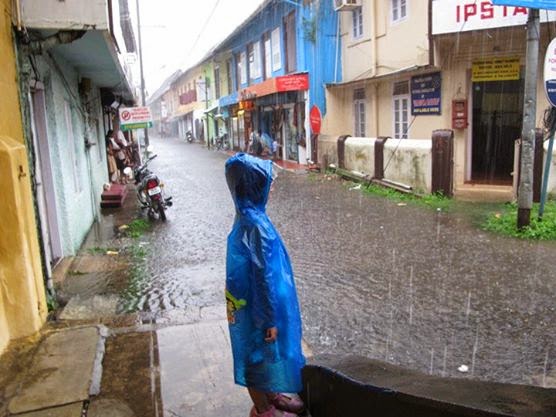
Such as it is, the monsoon has begun taking its toll on me. My fragile resolve to eat sensibly and shed some excess baggage has been shattered. Something about the rains makes me long for chaats (as in the dilli ones - aloo tikkis and papdi chaats, and the squishy, wintry sweet potato chaat you get outside Desmond's house in CP). Longing, lingering, lolloping thoughts of chat-pata sinful veggie food - the gujju kind, the marathi kind, and the debauched northie kind. And oh, the A-1 samosas at GK in Sion, with their madly tingly chhole. Strangely, for a confirmed carnivore like me, the thoughts are all about veggie stuff...

So I bought a packet of Kurkure, and ate it, hating myself. If things go on like this, I might be reduced to the Monaco-biscuits-and-tomato-ketch combo of yore...

What do the rains make you long for? (And it doesn't have to be just food!)

Wednesday, June 20, 2007

Oddballs, seedballs and Monet

Reading about BMC making people sign a petition for a toilet in the face of criticism from the Heritage Committee. So much bally cheek that is! This is the same corporation which doesn't maintain the gardens, loos, or municipal pools that it already has... The same article mentions a loo two minutes away which is in a dilapidated state. Why isn't